Showing posts with label EPA. Show all posts

Friday, January 11, 2013

How much of this stuff could NOT be done today?

http://www.youtube.com/watch?v=xTl417mfZGs


Ledbury Ox Roast 1953   


Uploaded on Mar 1, 2011
On June 2nd 1953 an ox was roasted in Ledbury's High Street to celebrate the coronation of Her Majesty Queen Elizabeth II.

Saturday, January 5, 2013

A warning from AAA about using a new E-15 labeled gasoline, it can ruin your car and void your warranty.

h/t CC


Warning Not to Use E15 Gas in Your Car


Do NOT use "E15 gas if your car was built before 2012, it will ruin your automobile engine and void your auto warranty.
 
Although its EPA approved, use of E-15 gas voids your warranty!
It is lower octane, and the ethanol (from corn or sugar) severely corrodes your fuel lines, gaskets, etc and ruins your car.
 
Contact your automobile dealer and your auto insurance company for details.
 
AAA disapproves the use of E15 fuel. 
 
Ethanol is mixed into the gasoline AT YOUR LOCAL Gas Station.  After mixing, it does not remain homogeneous: 'real' gasoline settles to the bottom so you burn the ethanol to quickly ruin your car.
 
Go to:
 

Thursday, August 16, 2012

What is the EPA hiding?


EPA LogoBy Rick Manning — The Environmental Protection Agency has been a lightning rod for controversy during the Obama Administration as they have pushed the applications of the Clean Air Act and the Clean Water Act to their limits in seeking to control all land use across the nation.
One area that hasn’t received as much scrutiny, but reeks of old-style influence peddler politics is the Agency’s escalation of sue and settle cases to change the law through federal court decree operating hand in hand with radical environmentalist groups that are willing participants in the scam.
Numerous media reports have focused upon the revolving door between the EPA and various environmentalist groups with hundreds officials reportedly moving back and forth between environmental agencies and those that lobby them.  The latest is Alfredo Armendariz, who resigned after a two year old video emerged of him explaining to environmental groups that the EPA’s enforcement policies compared favorably with those of the Roman Empire where they would crucify someone in a newly conquered town to create the necessary fear in the citizenry.
Now Armendariz is working with the Sierra Club on their anti-coal campaign, in just one more example of the cozy relationship between the advocacy groups and the government that they lobby.
And it is these very relationships that are at the heart of the sue and settle controversy enveloping the Obama Administration.  Here is how it works:
An organization sues the EPA demanding that they apply the law in a new, expanded way that increases the agency’s jurisdiction.  The EPA, rather than defending the actual law, enters into a contractual relationship known as a consent decree with the party who filed the original lawsuit.  A judge signs the consent decree without review, since the two disputing parties are in “agreement.”  And the EPA suddenly has expanded powers to wield its enforcement cudgel against people and job creators who were previously outside their grasp.
Shockingly, U.S. taxpayers are then required, under federal law, to pay off the attorneys of the organization which engaged in this power grab scam.
Americans for Limited Government filed a Freedom of Information Act (FOIA) request in May, 2012 (amended on June 14) to get to the bottom of one such sue and settle created regulation dealing with coal-ash.
The request simply asks for all communications between the EPA’s Offices, which entered into the legal agreement, and the eleven groups which sued the Agency including the Sierra Club, Chesapeake Climate Change Network and Physicians for Social Responsibility.
Not surprisingly, the EPA is stonewalling the request demanding that the costs of compiling the data be paid for by Americans for Limited Government in spite of the fact that the group has followed the exact procedures under the law which dictate that the information should be provided free of charge.  Similar Americans for Limited Government FOIA requests have been delivered without fee by more than a dozen other federal government departments and agencies.  Yet, the EPA objects.
Ironically, the EPA’s National Freedom of Information Act Officer, Larry Gottesman testifiedbefore the House Government Reform and Oversight Committee in 2010 stating, “EPA is committed to the letter and spirit of the Administration’s Open Government and Transparency goals.”
Apparently, that commitment does not extend to releasing information that promises to prove embarrassing to Obama and his hand in glove environmentalist advocacy group campaign to expand the EPA’s power through the dubious sue and settle process.
Gottesman’s attempts to stop the release of the communications between those who sued the EPA and the Agency which is supposed to defend the law, raises the following questions:
Is the National FOIA officer being coerced by Obama political appointees to stop the release of damaging information until after the November election?
What emails and other communications are so damaging that this career official would risk his reputation to keep them out of the public eye?
What communications have occurred related to the stonewalling of the original standard FOIA request?
The irony should not be lost that while the EPA lectures the rest of America on clean air, their own legal shenanigans are shrouded by a thick stench of obstructionism.
It’s time for America to know if the EPA is colluding with environmental radicals to manipulate the legal system with a promise that the radicals will get paid for their efforts through taxpayer funds.
It’s time for the EPA to come clean by releasing the communications between itself and the eleven organizations whose lawsuit led to the new proposed coal-ash regulations.
And it’s time for the EPA to disinfect their festering reputation as nothing more than a radical environmental advocacy organization with draconian enforcement powers rather than an even handed government agency.
Rick Manning is the communications director of Americans for Limited Government

http://netrightdaily.com/2012/08/what-is-the-epa-hiding/

Wednesday, August 15, 2012

EPA’s hazy outlook threatens to bankrupt coal-fired power plants


However, even amidst this beauty, the Environmental Protection Agency (EPA) is focused on the haze in the national park and says it is coming from a very important electricity source in the area.
The Navajo Generating Station (NGS), a coal-fired power plant that supplies electricity for the14 pumping stations required to move water to southern Arizona—to about 80 percent of the state’s population—is being blamed for creating poor air quality in the national park.
Currently, this power plant meets all federal clean air guidelines—except the EPA’s interpretation of the Regional Haze Rule.
The goal of the EPA’s Regional Haze Rule is the “remedying of any existing impairment of visibility” at 156 National Park and Wilderness areas throughout the U.S.  Congress approved of this amendment to the Clean Air Act in 1977, however, power to set standards of emissions was left to the states—not the EPA.  The EPA’s role was to simply provide support.
Now the EPA seems to be trampling on the state’s authority to control emissions standards by creating its own set of standards.  Is the EPA really that concerned about cleaning up haze or is this just another aggressive move to push out the coal industry?
If the EPA decides that the NGS power plant needs additional emissions control technology, owners of the power plant can expect to invest $1.1 billion, with no promise of improved air quality in the national park.
Furthermore, the plant is located on land owned by the Navajo Nation.  Its long-term lease with the tribe expires in 2019.  If the power plant operators can’t guarantee a renewed lease beyond 2019, investing more than $1 billion into the plant isn’t a viable option.  Depending on the EPA ruling, NGS might shutdown—costing 1,000 jobs, 90 percent of them belonging to the Navajo tribe.
Not only would this hurt the local economy, already plagued with high unemployment, but it would effectively destroy the water source to southern Arizona—leading to skyrocketing water rates.
How does the EPA get away with destroying communities like this one?
A political game.  It is no secret that many environmental groups ally with the EPA.  But what if these groups don’t think the EPA is doing its job or going far enough? They sue.  The EPA then settles agreeing to fix the problem. Therefore a court-imposed deadline on the EPA leaves it with no other option but to override the state’s regulations and enforce its own controls.
The U.S. Chamber of Commerce, in a report titled, “EPA’s New Regulatory Front: Regional Haze and the Takeover of State Programs,” highlights how the EPA, along with court-mandated deadlines, has wheedled its way into state territory by delaying state plans for emission control.
“By combining this tactic of delaying approval of the state plans with Sue and Settle and a court-imposed deadline to act, EPA has manufactured a loophole to provide itself with the ability to reach into the state haze decision-making process and supplant the state as decision maker. EPA has, effectively, engineered a way to get around the protections of state primacy built into the Regional Haze statute by Congress.”
The report goes on to say, “Since August 2011, EPA has used this method to impose almost $375 million in annual costs on ratepayers in New Mexico, Oklahoma, and North Dakota—over the staunch objection of their governors—by requiring installation of more costly controls than the BART [Best Available Retrofit Technology] controls each state chose.”
The Navajo Generating Station has already installed low nitrogen oxides burners and other technologies to reduce nitrogen oxides by 40 percent at a cost of $45 million.  If the state of Arizona approves of this level of emissions then according to Congress and the Clean Air Act, the EPA should as well.
The EPA’s true motive is clear: it is simply following the instructions of its leadership. In 2008,President Obama stated, “if somebody wants to build a coal-powered plant, they can; it’s just that it will bankrupt them because they’re going to be charged a huge sum for all that greenhouse gas that’s being emitted.”
As the EPA and this administration edge closer to their goal of bankrupting the coal industry, states have got to respond and fight back against this abuse of power.
This isn’t just a war against coal. It’s a war that challenges states rights’ and if it is lost will ensure the EPA’s overwhelming authority in just about anything it chooses.
Rebekah Rast is a contributing editor to Americans for Limited Government (ALG) andNetRightDaily.com.  You can follow her on twitter at @RebekahRast.

http://netrightdaily.com/2012/08/epas-hazy-outlook-threatens-to-bankrupt-coal-fired-power-plants/

Thursday, August 9, 2012

EPA foolishly seeks to destroy nation's coal industry


Published: August 2, 2012 


 — The U.S. Energy Information Administration estimates the share of U.S. electricity generated from coal will fall from 42 percent in 2011 to 36.8 percent in 2013.
Some of that decline is due to advances in fracking making cheaper natural gas available. That's bad news for coal miners but no different than problems all industries face from competition.
Cheaper natural gas cannot explain all coal's decline, however. A federal study found that coal use in electricity declined just 1.4 percent for every 10 percent change in relative prices between the coal and natural gas. This is not surprising because electric plants cannot change from coal to natural gas by just throwing a switch.
An important reason for coal's decline is the administration's war on coal.
Vice President Joe Biden made that clear during the 2008 campaign when he said the Obama policy was "No coal plants here in America." Similarly, candidate Obama told the San Francisco Chronicle that he would ensure that building a coal plant would "bankrupt" the operator because of the cost of complying with new carbon-dioxide emission regulations.
Deliberate government efforts to end an industry are not part of normal competitive market pressures and bad for the U.S. economy for three reasons.
First, virtually all our coal production goes directly to generate electricity. Changing that is costly: our electric grid was designed based on generation patterns dominated by multiple coal plants. Eliminating coal requires both costly new generation facilities and expensive grid modifications.
Moreover, while the rapid development of domestic natural gas is cutting generation costs today, it is not guaranteed to continue indefinitely. If anti-fracking activists - who are also often anti-coal activists - succeed in their campaign to restrict natural gas production and pipeline construction, natural gas costs will rise.
Second, diversity in sources enhances our energy security by minimizing the chance that politics or wars in unstable and unfriendly countries will disrupt our energy supplies.
America is called the "Saudi Arabia of coal" because it has more than a quarter of world coal reserves. Energy security is vital because energy is embedded in most goods and services. Almost half of our energy use is indirect and so invisible to consumers. Among the most energy intensive sectors of our economy are health care and food; we risk much more than higher utility bills if we remain vulnerable to unfriendly and unstable energy suppliers.
Third, the coal industry is a significant source of jobs. The typical coal miner earns $73,000 a year, says the National Mining Association, which represents the mining industry in Washington.
An estimated 60,000 Americans work in coal-fired power plants. These are high-productivity jobs because the employees work with large amounts of capital. Electricity generated by coal takes just 0.18 employees per megawatt of plant capacity.Coal-fired power plant jobs pay high wages because their employees are skilled. Yet new EPA regulations are estimated to cut total coal employment by 1.4 million job-years between 2011 and 2020.
Besides destroying jobs, the new regulations imposed by the administration will lead to the closing of 40 gigawatts of electric generation capacity. A staggering 12 percent of America's current coal capacity will be shut down. There could be many long, hot summers if we lose these reliable sources of power.
Coal plays a key role in electricity generation. The power produced from coal-fired plants is embedded in everything from our prescription medications to the food we eat.
Tens of thousands of Americans earn good livings in coal-related industries. Domestically produced coal reduces our dependence on unstable and unfriendly suppliers.
Those facts make it obvious that market forces - not Washington bureaucrats - should determine the role coal plays in our economy.
ABOUT THE WRITER
Andrew Morriss is a law professor at the University of Alabama. Readers may write him at 101 Paul W. Bryant Drive East, Tuscaloosa, Ala. 35487; email: amorriss@law.ua.edu.
This essay is available to McClatchy-Tribune News Service subscribers. McClatchy-Tribune did not subsidize the writing of this column; the opinions are those of the writer and do not necessarily represent the views of McClatchy-Tribune or its editors.
2012 McClatchy-Tribune


Read more here: http://www.bradenton.com/2012/08/02/4139700/epa-foolishly-seeks-to-destroy.html#storylink=cpy#storylink=cpy


Tuesday, July 31, 2012

El Presidente is doing it to us again - water on private property

This is part of the UN Agenda 21


Landowner engages in clean water act; receives EPA fine

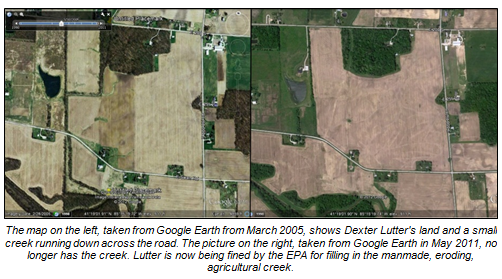
By Rebekah Rast — Dexter Lutter was expecting an award; instead he got a $20,000 fine.
He made environmental improvements on his land — his farm — by taking steps to clean up the water supply and better preserve the soil, but the Environmental Protection Agency (EPA) and U.S. Army Corps of Engineers fined him for his efforts.
“That’s how out of touch I am,” Lutter says.  “I feel like we should have won a medal for what we did, but the EPA tells us we were wrong.”
A small manmade open ditch ran through Lutter’s property in Noble County, Ind.  It was in need of repair, and Lutter got permission from his county to place tile drains for the collection of the agricultural discharge and cover over the eroding open ditch.  This not only saved county taxpayer dollars, but also cleaned up the water supply and prevented further soil erosion.
But that doesn’t matter. According to Noble County and Lutter, they were told they violated the Clean Water Act.  This is despite the fact that Lutter said the ditch was manmade and used only for agricultural discharge and did not impede the flow of any main waterways — usual exemptions under the Clean Water Act.
It seems both the EPA and Army Corps are no longer content just monitoring activity in “navigable” waterways—as stated in the Clean Water Act, which has commonly lent itself to waterways where a vessel could in fact, navigate.  These agencies seem to think they need to adopt a different interpretation of the law, which gets them another step closer to controlling all water in the U.S.
This means many more cases similar to Lutter’s will begin to surface.
Imagine if the EPA and Army Corps held the power to regulate any and all water they saw fit — water from a roadside ditch to a puddle in your yard?  It’s a scary thought and greatly threatens farmers and landowners like Lutter, who now owes the EPA a hefty fine since it was his personal business that paid for much of the cleanup.
For Noble County, this Clean Water Act violation means a $75,000 fine and an additional $100,000 or more in mitigation costs to satisfy EPA and Army Corps of Engineers, says Scott Zeigler, Noble County Surveyor.
If manmade ditches, creeks and drainage system are in line to fall under the jurisdiction of the EPA and/or the Army Corps of Engineers, then any farmer with a backed up drainage system or broken tile drain might need a permit before they can even be fixed.  Likewise, any land you may own and would like to build on that had a standing puddle could potentially result in a rejected permit for disrupting a “wetland.”
This is very similar to what happened to Mike and Chantell Sackett.
They bought land in Idaho and decided to build a home.  Once they filled the land with dirt and rocks in preparation, the EPA showed up asking for a permit claiming they had illegally filled protected wetlands and would contaminate a somewhat nearby lake.  However, between the lake and the Sackett’s home were “several lots containing permanent structures.”  Nonetheless, the Sackett’s were ordered to stop all renovations.
The case made its way to the Supreme Court earlier this year, and a unanimous decisionstated that the Sackett’s deserved their day in court — and most importantly that EPA actions are accountable to the justice system.
The Sackett’s can now take their case against the EPA to court — a journey not many are willing to take due to the high price of fighting against a large government bureaucracy.  Chief Justice John Roberts pointed out during the oral arguments of the case that because of potential fines few people are going to challenge the EPA’s decisions:
“Because of the administrative compliance order, you’re really never going to be put to the test, because most land owners aren’t going to say, ‘I’m going to risk the $37,000 a day.’ All EPA has to do is make whatever finding it wants, and realize that in 99 percent of the cases, it’s never going to be put to the test.”
With a hefty fine like $37,000 a day as Chief Justice Roberts used as an example, or even Lutter’s $20,000 fine, it is easy to see why people are scared away from pushing back against the heavy-handed EPA.
As Lutter and his attorney are attempting to negotiate with the EPA in hope of lowering the fine, elected officials in Noble County are also wondering how to pay their fine of $75,000, not to mention the possibly more than $100,000 in mitigation costs to satisfy the Army Corps.
“We filled in a ditch that was about 2 to 3 feet wide and about 10 to 12 inches deep,” says Noble County Surveyor Scott Zeigler.  “We did something to save taxpayers money and now we have to pay out almost $200,000 in penalties.”
Is this the penalty for folks who clean up the environment and are good stewards of their land?
The mitigation project for Noble County includes planting many new trees and implementing new practices that will detain water, resulting in water moving slower from farms.  So far this hasn’t been a welcomed project.
If the EPA and Army Corps are successful in their bid to reinterpret the Clean Water Act, these agencies will be responsible for every drop of water in the U.S. — even more so than they are now.
“This paints a picture of the insanity of the EPA,” says Bill Wilson, president of Americans for Limited Government (ALG).  “The people making these decisions are so radical that even attempting to reform the EPA will do no good — the agency needs a complete overhaul.  The job of the next administration will be to restructure and re-staff this rogue government agency.”
For now, Lutter is hoping he didn’t just lose his business over successfully cleaning up the water supply and creating a healthier environment for years to come.
Rebekah Rast is a contributing editor to Americans for Limited Government (ALG) andNetRightDaily.com.  You can follow her on twitter at @RebekahRast.

http://netrightdaily.com/2012/07/landowner-engages-in-clean-water-act-receives-epa-fine/